North Dakota Snagging Regulations for Paddlefish
Trying to understand all the specific rules for paddlefish snagging in North Dakota can feel a bit overwhelming, especially when you're just eager to get out on the water. Many anglers grapple with ensuring they have the correct licenses, are in the right spot at the right time, and are using legal gear, because nobody wants a fantastic fishing trip to turn into a regulatory headache. This comprehensive guide will meticulously clarify all the North Dakota snagging regulations for paddlefish, providing you with clear, detailed information so you can enjoy a worry-free and successful snagging experience.
Understanding North Dakota's Paddlefish Snagging Season
Paddlefish snagging in North Dakota is a truly unique angling experience, drawing enthusiasts from all over. Unlike traditional fishing, where fish are enticed by bait, paddlefish are snagged due to their filter-feeding nature and the specific times of year they concentrate in certain river systems. However, this also means there are very specific rules about when and where you can participate.
When and Where Paddlefish Snagging is Permitted
The paddlefish snagging season in North Dakota is a tightly controlled event, primarily focused on a short window in the spring. Generally, the season kicks off in early May and runs for a specific number of days, usually concluding before the end of the month. It's not a year-round affair; this limited timeframe is crucial for managing the population and ensuring the sustainability of this ancient species. The North Dakota Game and Fish Department sets these dates annually, so it's always wise to double-check their most current proclamation. You can usually find the most up-to-date information in the annual North Dakota Fishing Season Dates and Limits.
The designated snagging areas are equally specific. The primary action takes place in the Missouri River System, particularly around the confluence of the Yellowstone and Missouri Rivers, upstream to the Montana border, and in sections downstream towards Lake Sakakawea. Key areas often include the confluence near Williston, and the stretch of the Missouri River below Garrison Dam. These locations are chosen because paddlefish concentrate there during their spawning migrations, making them accessible to anglers. It's not just any river or lake; it's specific stretches where the Department has deemed snagging appropriate and manageable. For a full breakdown of where snagging is permitted, be sure to consult Where Is Paddlefish Snagging Legal in North Dakota?.
Why Paddlefish Snagging is Unique
Paddlefish are fascinating creatures, often called "living fossils" because their lineage dates back millions of years. They are entirely filter feeders, sifting plankton from the water with their large mouths, which means they don't bite hooks with traditional bait like a walleye or a catfish would. This biological fact is why snagging, a method of hooking the fish externally, is the primary way to catch them. It's a method that requires considerable physical effort and heavy tackle, quite different from the finesse required for, say, fly fishing for trout.
This distinction from conventional fishing methods leads to a different set of regulations and a unique angling culture. While most fishing focuses on the fish's predatory instincts, paddlefishing centers on intercepting their migratory paths and the sheer force required to reel in a large, powerful fish that isn't actively feeding on your bait. This specific approach necessitates stringent rules to prevent overharvesting, given the paddlefish's slow growth rate and late maturity. The intensity and short duration of the season, along with the specific gear requirements, set paddlefish snagging apart from nearly any other fishing experience in the state.
Essential Permits and Licensing for Paddlefish Snagging
Before you even think about casting a line for these incredible fish, understanding the necessary permits and licenses is paramount. Skipping this step can lead to hefty fines and a ruined day on the water, so it's always best to be prepared and compliant.
General Fishing License Requirements
First and foremost, any angler aged 16 or older needs a valid North Dakota fishing license to participate in paddlefish snagging, just like they would for any other type of fishing. This isn't an optional extra; it's the foundation of legal angling in the state. For a complete overview, check out our North Dakota Fishing License Guide. Whether you're a resident who's lived in the state your whole life or an excited visitor from out-of-state, everyone needs to ensure their general fishing license is current. Nonresidents, in particular, should familiarize themselves with the specific options available to them, as detailed in the North Dakota Nonresident Fishing License Guide.
In addition to the general fishing license, North Dakota requires individuals aged 16 and older to possess a Fishing, Hunting, Furbearer Certificate. This certificate helps fund wildlife conservation efforts across the state. It's a small additional step, but an essential one to ensure you're fully licensed for your paddlefish adventure. We've got a detailed explanation of its purpose and how to acquire it in The Fishing, Hunting, Furbearer Certificate Explained. Make sure you secure both your fishing license and this certificate well in advance of your trip, as prime snagging dates can sometimes coincide with busy periods for license sales.
Specific Paddlefish Tag and Registration
Beyond the general fishing license and certificate, snagging for paddlefish requires a special paddlefish tag. This tag is perhaps the most critical component for legal paddlefishing. Do You Need a Paddlefish Tag in North Dakota? The state issues a limited number of these tags, often through a lottery system for specific, highly sought-after zones, such as the prime confluence area near Williston. This lottery helps manage angler pressure and harvest rates in the most productive waters. If you're fortunate enough to draw a tag for one of these areas, you're permitted to harvest one paddlefish during the season.
It's absolutely essential to understand that once you successfully snag a paddlefish and decide to keep it, your tag must be immediately attached to the fish as per regulations. This ensures that each kept fish is properly accounted for and prevents someone from harvesting multiple fish on a single tag. You must also immediately register your catch at one of the designated paddlefish check stations. These stations are usually located conveniently near the main snagging areas, like the Missouri River System access points. Failing to possess a valid paddlefish tag, or neglecting to tag and register your catch, can result in severe penalties, including significant fines and potential revocation of fishing privileges. To understand the full implications, you can refer to Penalties for Fishing Without a License in North Dakota. This strict system is in place to protect the fragile paddlefish population, which is slow to reproduce and vulnerable to overharvesting.
Legal Gear and Techniques for a Successful Snagging Trip
Paddlefish snagging isn't your average leisurely cast-and-wait scenario; it's a physically demanding activity that requires specialized, heavy-duty gear and a specific technique to be both effective and compliant with North Dakota regulations.
Approved Snagging Equipment
When it comes to tackle, think robust and heavy-duty. You'll need a stout, strong fishing rod, typically 7 to 9 feet in length, capable of handling significant weight and the immense power of a large paddlefish. Many anglers opt for rods designed for saltwater fishing or heavy catfish setups. Matching this rod should be a large, durable reel, often a baitcasting or conventional reel, spooled with heavy braided line, usually 80 to 100-pound test. The sheer force exerted by these large fish, coupled with the heavy lead weights needed to get your hook down, demands equipment that won't fail under pressure.
The hooks themselves are also highly regulated. North Dakota mandates the use of barbless hooks. This is a critical detail, as using barbed hooks is illegal. Furthermore, there are often restrictions on the total number of hooks that can be attached to your line (typically no more than two hooks per line) and sometimes even the maximum gap size for the hook. Anglers often turn to online retailers like Amazon for specialized paddlefish snagging hooks, often available in large sizes (like 10/0 or 12/0) with the required barbless design. You'll also need heavy lead weights, often 8 to 16 ounces, to quickly sink your line in the strong river currents. Don't forget robust gloves, which are crucial for handling a large paddlefish and protecting your hands from the rough scales and fins; you can grab a durable pair on Amazon that offers excellent grip and protection.
Proper Snagging Methods and Safety
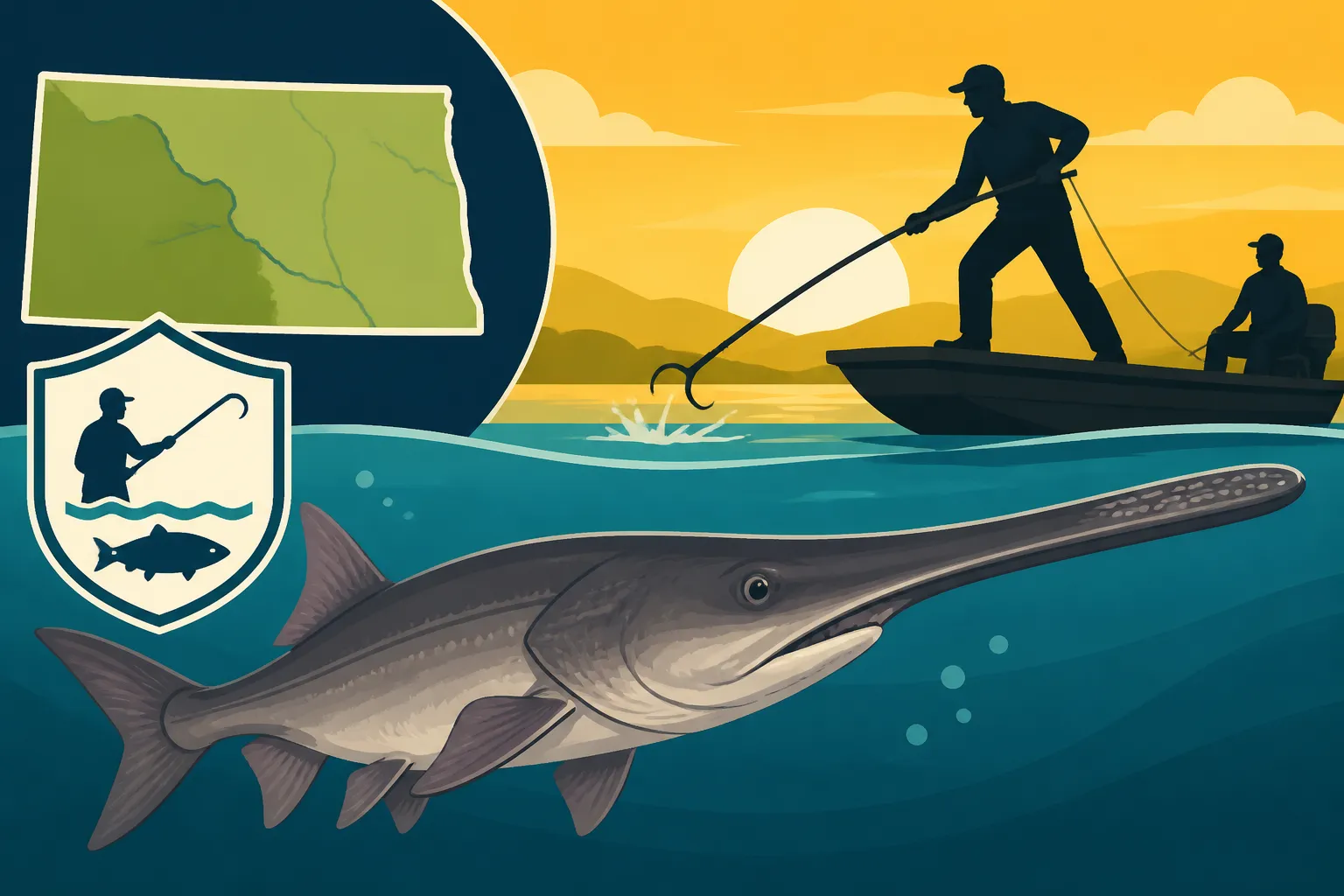
The technique for snagging a paddlefish involves casting heavy tackle into areas where schools of paddlefish are concentrated, then rapidly reeling in the line to "snag" the fish by external contact. It’s a sweep-and-retrieve motion, essentially trying to hook the fish anywhere on its body as you retrieve your line through the water column. This isn't a gentle finesse game; it requires repeated, powerful casts and quick, strong retrieves, which can be exhausting over a full day.
Safety is paramount during paddlefish snagging, especially given the heavy weights and large hooks being cast. Always be mindful of other anglers around you, maintaining a safe distance to avoid accidental injury from errant casts. The banks of the Missouri River can be steep and muddy, especially during the spring runoff, so wear appropriate footwear with good traction. Handling a large paddlefish, which can weigh upwards of 100 pounds and be several feet long, also requires care. Their skin is rough, and their paddle-like rostrum can be cumbersome. A sturdy gaff or a very large landing net is often used to bring these fish ashore safely. Always be prepared for the fight, and know your limits. Adhering to all aspects of the North Dakota Fishing Regulations Explained will not only keep you legal but also ensure a safer and more enjoyable experience for everyone.
Daily Limits, Possession Limits, and Handling Your Catch
Successfully snagging a paddlefish is an exhilarating moment, but the journey isn't over once the fish is on the bank. Understanding and following the rules for limits and proper handling is crucial for compliance and for ensuring the health of the paddlefish population.
Understanding Paddlefish Limits
When it comes to paddlefish, the limits are straightforward but incredibly strict: typically, the daily and possession limit is one paddlefish per angler, per season, if you possess a valid paddlefish tag. This isn't like walleye fishing, where you might have a daily limit of four and a possession limit of eight. For paddlefish, once you harvest and tag your one fish for the season, you're done. You cannot keep another paddlefish, even if you continue fishing. This singular focus on one fish per season per tag underscores the conservation efforts for this species.
It's vital to clearly distinguish this from other species' limits. For example, North Dakota Walleye Size Limit Rules allow for multiple fish per day and season, provided they meet size requirements. Paddlefish regulations are much more restrictive due to the species' vulnerability and unique life history. The "one and done" rule for paddlefish means that thoughtful consideration should be given before harvesting a fish. If you snag a smaller fish, for instance, you might choose to release it, hoping for a larger one later in the season (within the designated snagging period), knowing that any fish you keep will fulfill your tag for that year.
Handling and Releasing Unwanted Fish
Not every paddlefish you snag will be a keeper. Perhaps it's too small, or you've already harvested your seasonal limit, or it's simply a fish you prefer to release. In these situations, quick and careful release is not just good practice, it's often a regulatory requirement to minimize harm to the fish. When a paddlefish is snagged, it can be hooked in various parts of its body, not just the mouth. This can be more traumatic than a traditional mouth hook.
If you intend to release a paddlefish, do so as quickly and gently as possible. Avoid dragging it onto dry land unless absolutely necessary. Try to keep the fish in the water as much as possible while you remove the hook. If you must bring it out, use a gaff or large net to support its body, and get it back into the water promptly. Minimize handling, especially by its delicate rostrum (the long, paddle-like snout), as this is crucial for its feeding mechanism. The goal is to maximize its chances of survival once released, ensuring it can continue its journey and contribute to future generations. This careful approach aligns with the overall conservation goals for paddlefish in North Dakota.
Post-Catch Procedures and Transport
Once you've made the decision to keep a paddlefish, the post-catch procedures are immediate and non-negotiable. As soon as the fish is landed, your valid paddlefish tag must be immediately affixed to it. This typically involves attaching the tag to the fish's body, usually near the dorsal fin, in a manner that it cannot be removed without being destroyed. This serves as proof of legal harvest.
Following tagging, you are required to register your catch at a designated paddlefish check station. These stations, typically located near prime snagging spots like those along the Missouri River, are crucial for the North Dakota Game and Fish Department to collect vital data on harvest numbers, fish size, and population health. During registration, biologists may measure and weigh your fish, and sometimes collect tissue samples. You'll receive a receipt or confirmation of registration. Until the fish is fully processed for consumption at your home or cabin, the tag must remain attached to the paddlefish. When transporting the fish, especially if you're traveling a significant distance, it must be easily identifiable and accessible for inspection by game wardens. Removing the tag or failing to register your catch before transport could lead to serious legal consequences.
Key Paddlefish Snagging Locations and Conservation Efforts
North Dakota's paddlefish snagging is concentrated in specific areas where these majestic fish congregate, making certain spots legendary among anglers. These locations are not just popular; they are critical habitats for the species, emphasizing the importance of stringent regulations and ongoing conservation efforts.
Prime Snagging Spots in North Dakota
Without a doubt, the confluence of the Yellowstone River and the Missouri River near Williston, North Dakota, is the undisputed king of paddlefish snagging locations. This area, often referred to simply as "The Confluence," is where paddlefish from Lake Sakakawea and other parts of the Missouri River system gather during their spring spawning run. The specific river conditions and habitat here create a natural funnel, concentrating the fish and offering the best chances for anglers. It's a bustling scene during the short snagging season, with hundreds of anglers lining the banks, eagerly casting for their chance at a trophy.
Other significant locations along the Missouri River also offer snagging opportunities, although often with different regulations or tag requirements. The stretches of the Missouri River below Garrison Dam can also hold paddlefish, particularly as they migrate. Access points along these rivers are generally well-maintained, but during peak season, parking and prime fishing spots can fill up quickly. Many anglers will arrive before dawn to secure their desired spot. It's always advisable to scout your chosen location beforehand if possible, or consult local bait shops and the North Dakota Game and Fish Department for current conditions and access information. For more detailed information on specific areas, including maps and access points, you can explore guides like Paddlefish Snagging Season on the Missouri River.
Why Regulations are So Strict: Protecting the Species
The reason for such tight regulations on paddlefish snagging is deeply rooted in the biology and vulnerability of the species. Paddlefish are incredibly long-lived, often reaching ages of 20 to 30 years, but they are also slow-growing and mature very late in life. Females, for instance, may not begin spawning until they are 7 to 10 years old, or even older. This slow reproductive cycle means that their populations are highly susceptible to overfishing. If too many paddlefish are harvested, it takes a very long time for the population to recover, potentially leading to a decline that could be difficult, if not impossible, to reverse.
The North Dakota Game and Fish Department (NDGFD) plays a crucial role in managing these populations. They conduct extensive studies, monitor snagging success rates, collect biological data at check stations, and adjust regulations—such as season length, tag numbers, and specific open areas—to ensure the health and sustainability of the paddlefish fishery. These efforts include ongoing stocking programs and habitat protection initiatives. Anglers' adherence to all rules, including catch limits and proper release techniques for unwanted fish, directly contributes to these conservation goals. Every regulation, from the specific season dates to the requirement for a paddlefish tag, is designed to strike a delicate balance between allowing recreational fishing and safeguarding this iconic North Dakota species for future generations. Staying informed on all North Dakota Fishing Season Dates and Limits is part of being a responsible angler.
North Dakota Paddlefish Snagging Regulations Summary
To help keep all these details straight, here's a handy summary of the key regulations for paddlefish snagging in North Dakota:
| Regulation Aspect | Details |
|---|---|
| General License | Mandatory for all anglers 16 years and older. Includes a valid North Dakota fishing license and the Fishing, Hunting, Furbearer Certificate. |
| Paddlefish Tag | Required in addition to a general fishing license. Often issued via lottery for prime zones (e.g., Confluence area). One tag permits one paddlefish harvest per season. |
| Snagging Season | Typically a short window in early May. Exact dates are set annually by the NDGFD. Always check the current proclamation. |
| Legal Zones | Primarily the Missouri River System, including the Yellowstone/Missouri River confluence area and specific stretches below Garrison Dam. Refer to official maps for precise boundaries. |
| Daily/Season Limit | One (1) paddlefish per valid tag, per season. Once a fish is kept, the tag is used, and the angler cannot keep another paddlefish for the remainder of the season. |
| Approved Gear | Heavy-duty rod and reel, strong braided line (80-100 lb test recommended). Barbless hooks only, typically no more than two per line. Heavy lead weights (8-16 oz) are common. |
| Tagging & Reporting | The paddlefish tag must be immediately affixed to the harvested fish. The fish must be registered at a designated check station before leaving the area. The tag must remain on the fish until it is processed for consumption. |
| Releasing Fish | Unwanted fish, or those caught after the limit is met, must be released quickly and carefully to minimize harm. Avoid dragging on land; keep in water as much as possible during hook removal. |
| Conservation Focus | Regulations are strict due to paddlefish's slow growth, late maturity, and long lifespan, making them vulnerable to overharvest. Adherence ensures sustainability. |
Remember, this table provides a snapshot, but it's always best to consult the official North Dakota Game and Fish Department regulations for the most current and specific details each year.
Disclaimer
The information provided in this guide is for general informational purposes only and is subject to change. While we strive to offer accurate and up-to-date content, fishing regulations, season dates, and licensing requirements can be updated by the North Dakota Game and Fish Department at any time. It is the sole responsibility of the angler to consult the current official North Dakota Fishing Proclamation or contact the North Dakota Game and Fish Department directly before engaging in any fishing activities to ensure full compliance with all applicable laws and regulations.