Best Wind Conditions for Walleye Fishing
Anyone who’s spent a decent amount of time fishing in North Dakota knows that calm, glassy water days are about as rare as a quiet Saturday at a popular boat ramp. More often than not, you're battling the wind, which can be incredibly frustrating when you're trying to present a lure or simply keep your boat on a spot. But here's the kicker: for walleye anglers, wind isn't always the enemy. In fact, understanding and leveraging specific wind conditions can actually transform a tough day into a phenomenal one. This guide will help you decode North Dakota's notoriously blustery conditions and use them to your advantage when chasing walleye.
Understanding North Dakota's Winds and Walleye Behavior
North Dakota is renowned for its wide-open prairies and, consequently, its consistent wind. This isn't just a minor inconvenience; it's a fundamental aspect of fishing here, especially when you're targeting walleye. Learning how to read the wind and predict its effects on the water and, more importantly, on the fish, is a skill that separates the consistently successful anglers from those who just get lucky.
The Constant Challenge of Prairie Winds
Let's be real: "windy" is often the default weather setting in North Dakota. It can shift directions, pick up speed, and create conditions that make boat control a nightmare and casting feel like a CrossFit workout. The wind directly impacts the water by creating waves, generating currents, and stirring up the bottom, which leads to increased turbidity. These factors might seem like a disadvantage, and sometimes they certainly are, but they also trigger a chain reaction that often benefits walleye fishing. Imagine a persistent north wind blowing across a large reservoir like Lake Sakakawea; it's not just moving your boat, it's pushing surface water, creating an underwater current, and piling up baitfish on the leeward side of structures.
When you're out there, fighting the gusts, it’s easy to feel defeated. I've been there, thinking, "Why bother? I can't even feel my jig." But instead of giving up, seasoned anglers know that these conditions are precisely when some of the best fishing can happen. The key is understanding how walleye utilize these windy conditions to their advantage, and then adjusting your tactics to match. The wind isn't just a force to contend with; it's a dynamic element that reshapes the underwater environment, concentrating food and providing cover for these elusive predators.
How Walleye React to Wind
Walleye are incredibly light-sensitive fish. Their large eyes are designed to gather light in low-light conditions, giving them a distinct advantage over their prey during dawn, dusk, cloudy days, or in deeper, darker water. This is why a bit of surface disturbance from the wind is often a good thing. The chop on the water's surface breaks up sunlight penetration, diffusing it and creating a more comfortable, "walleye-friendly" environment closer to the surface or in shallower water than they might typically inhabit on a calm, sunny day. It’s like turning down a floodlight so they can hunt more effectively.
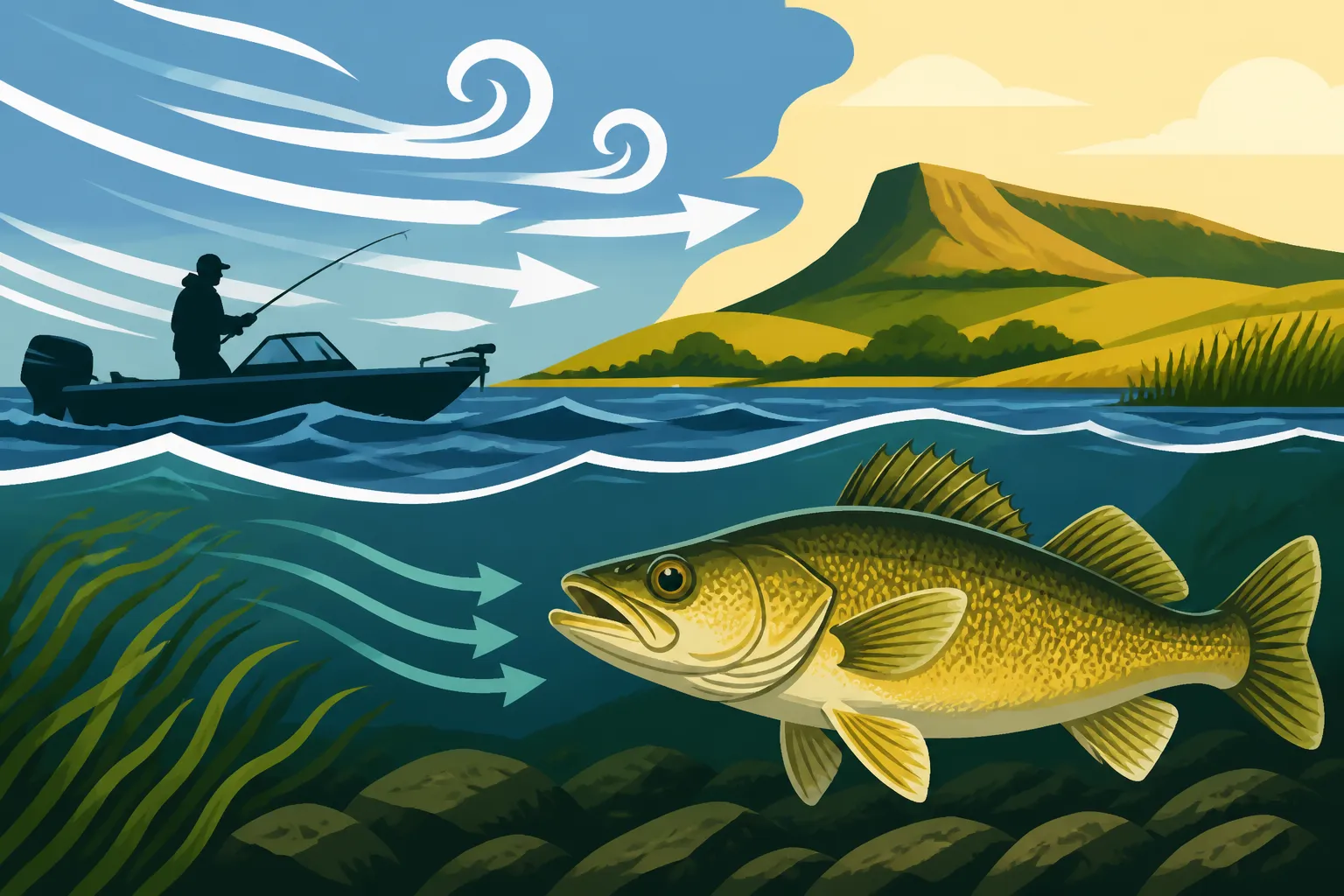
Beyond light penetration, wind-driven currents play a huge role. Wind pushes baitfish – think shiners, ciscoes, or even young perch – into specific areas, often against points, shallow flats, or into bays. This concentration of food is like ringing a dinner bell for walleye. They'll position themselves strategically, often on the downwind side of structure, waiting for an easy meal to be delivered to them. The current also helps oxygenate the water, and in some cases, stirs up the bottom, dislodging invertebrates and small organisms that baitfish feed on, further perpetuating the food chain. So, while you might be struggling to keep your hat on, the walleye are often thriving in the choppier waters, using the wind to their hunting advantage.
Favorable Wind Conditions for Walleye
When it comes to walleye fishing in North Dakota, not all wind is created equal. There are specific conditions that can make walleye more aggressive and predictable, and learning to identify these "sweet spots" in the weather forecast is crucial. It’s about more than just feeling a breeze; it's about understanding the subtle dance between wind, water, and fish behavior.
The "Walleye Chop" and Why It Works
If there’s one phrase you’ll hear repeatedly among dedicated walleye anglers, it’s "walleye chop." This refers to a light to moderate wind, typically blowing between 10 to 20 miles per hour, that creates a noticeable ripple or small wave on the water's surface. This isn’t a white-capping gale, but a steady, consistent chop that transforms the lake surface into a mosaic of moving light and shadow.
The magic of the walleye chop lies in several key factors. First, and perhaps most important, it significantly reduces light penetration into the water. Walleye, being visual predators with excellent low-light vision, become much more comfortable moving into shallower water or suspending higher in the water column when the sun's glare is broken up by the waves. This effectively extends their prime feeding times beyond just dawn and dusk. Second, this consistent chop creates a subtle current. Even in seemingly still lakes, a steady wind will generate a directional flow of water, pushing plankton, baitfish, and dislodged invertebrates. Walleye will instinctively position themselves on the downwind side of structures, points, or breaks, facing into this current, waiting for food to be carried to them. It's an energy-efficient hunting strategy that makes them easier to target. Finally, the surface disturbance acts as a natural camouflage. Your boat, your line, and even the subtle movements you make are harder for wary walleye to detect when the water is agitated. It gives you a critical edge, especially on clear North Dakota lakes like Lake Audubon or Jamestown Reservoir. This makes it a prime condition for tactics like Trolling Crankbaits for Walleye, where the chop can also add an enticing erratic action to your lures.
Consistent, Moderate Wind Direction
While the intensity of the wind is important, its consistency in direction is equally vital for predictable walleye patterns. A wind that blows steadily from the same direction for several hours, or even a couple of days, will establish clear feeding lanes and concentrate baitfish in specific areas. Think of it like a conveyor belt for food. When the wind direction is erratic and constantly shifting, baitfish scatter, and walleye tend to become less predictable in their movements. They might hold tighter to structure or suspend more randomly.
However, a sustained north wind, for instance, pushing across a long stretch of Lake Sakakawea, will steadily drive water and baitfish towards the south-facing shorelines or the southern side of main lake points and reefs. Walleye will learn these patterns and actively move to these "pushed" zones, setting up shop where the food supply is most reliable. This is why paying attention to the forecast not just for wind speed, but also for sustained direction, can make a huge difference. Knowing the prevailing wind direction can guide you to the exact side of a bay, point, or submerged hump where the walleye are likely to be stacked up. For shore anglers, understanding how the wind directs current and food can pinpoint the Best Wind Direction for Shore Fishing in specific locations.
Challenging Wind Conditions and How to Adapt
While a moderate chop can be your best friend, North Dakota is notorious for delivering winds that are far from ideal. Learning to cope with, and even mitigate the effects of, truly challenging wind conditions is a rite of passage for any angler here. It's about safety first, then smart adaptation.
High Winds and Gale Force Conditions
Let's face it, when the forecast calls for winds over 25 mph, or worse, those 30+ mph gusts that kick up whitecaps and make your boat feel like a toy, it's often best to reconsider your fishing plans. Safety should always be your number one priority, especially on large, unpredictable bodies of water like Lake Sakakawea or Devils Lake. These high winds can create dangerous waves, make boat control nearly impossible, and turn a simple run across the lake into a harrowing experience. Even casting becomes a frustrating exercise in untangling backlashes and fighting your lure's trajectory. If you find yourself in these conditions, or if the wind picks up unexpectedly, don't hesitate to head to a safe harbor or pull your boat out of the water.
However, if you're determined to get out or if the high winds are confined to certain areas, there are ways to adapt. The key is to seek shelter. Look for leeward shorelines, deep, protected bays, or the inside bends of rivers like the Missouri. These areas will offer a reprieve from the direct assault of the wind, allowing you to maintain some semblance of boat control and make effective presentations. While the big walleye might still be active on the main lake’s wind-blown structures, the risk-to-reward ratio often isn't worth it. Instead, focus on finding areas where the wind's direct impact is minimized, allowing you to fish safely and effectively. Sometimes, it's about fishing the edges of the wind-swept areas, where baitfish are being pushed in but the waves aren't quite as treacherous. Always prioritize your safety and be aware of your boat's capabilities and your own limitations when dealing with strong winds; for more specific advice, check out Fishing in North Dakota's Windy Conditions.
No Wind (Dead Calm) Conditions
Paradoxically, completely calm conditions can be just as challenging for walleye fishing as extremely windy ones, though for entirely different reasons. When the water is glassy and the sun is high, walleye become incredibly wary and skittish. The lack of surface chop means maximum light penetration, making them vulnerable to predators and less willing to venture out from cover or deeper water. It's like fishing in an aquarium where every movement is magnified. They have an excellent vantage point to see everything above them, and often use it to avoid detection.
In these dead calm scenarios, your approach needs to shift dramatically. Forget aggressive, flashy presentations. Instead, think subtle, stealthy, and low-light. Your best bet is to target walleye during the absolute lowest light periods: pre-dawn and post-dusk. These are the times when they feel most comfortable moving shallower to feed. During the bright parts of the day, focus on deeper water, sharp breaks, or areas with significant overhead cover like submerged timber or thick weed beds. Ultra-light lines, natural baits presented as gently as possible, and a slow, methodical approach are key. Minimize boat noise, keep your profile low, and consider trolling at incredibly slow speeds with natural-colored baits. This is when finesse really shines. It’s also a good time to remember that Do Walleye Bite Better at Night? can be especially true under calm, clear skies.
Reading the Wind and Locating Walleye
Understanding how wind influences walleye behavior is one thing; putting that knowledge into practice to actually find fish is another. It requires a keen eye for subtle clues on the water and a good understanding of how wind interacts with different types of underwater structure.
Fishing the Wind-Blown Shorelines and Structure
The golden rule of walleye fishing in windy conditions is often: "Fish the wind." But it's not quite as simple as just going to the choppiest water. It’s about understanding where the wind is pushing everything – baitfish, plankton, and even warmer surface water – and where walleye will position themselves to intercept that flow.
Imagine a persistent west wind blowing across a large North Dakota lake like Devils Lake. This wind will drive surface water and the microscopic organisms within it toward the eastern shorelines. This, in turn, attracts baitfish that feed on those organisms. The walleye, being opportunistic predators, will follow. They won't necessarily be in the teeth of the waves, struggling against the current. Instead, they'll often hold just off the wind-blown structure, maybe on the downwind side of a point, a weed line, or a submerged hump, facing into the incoming flow. This allows them to ambush baitfish that are being funneled past them with minimal effort. Look for areas where the wind is funneling into a narrow bay, pushing baitfish into a corner, or creating a current seam around a prominent point. These are high-percentage areas.
When approaching these spots, think about boat control. You want to present your lure effectively into the current, not be blown over the spot before you can even get a read on it. You might need to make longer drifts, or use your trolling motor more actively to maintain a consistent speed and angle. This kind of nuanced approach can be the difference between a few bites and a full livewell.
Utilizing Wind to Your Advantage for Boat Control
The wind can be a friend or foe when it comes to boat control. On one hand, it can push you around, making precise presentations difficult. On the other, with the right tools and techniques, you can use it to create highly effective drifts that cover water and trigger bites. This is where mastering your boat and its accessories becomes crucial.
One of the best ways to manage wind is with a good bow-mounted electric trolling motor. Brands like Minn Kota and MotorGuide offer excellent models with GPS-based spot-lock features, which are absolute game-changers in North Dakota's windy environment. Imagine being able to "anchor" electronically over a precise piece of structure, even in a stiff breeze, without ever dropping a physical anchor. This precision allows you to saturate a productive area with casts or vertical jigging presentations. Many anglers find great deals on these powerful tools on platforms like Amazon, making them accessible.
Another invaluable tool is the drift sock, also known as a sea anchor. This simple device, deployed off the bow or stern, acts like a parachute in the water, slowing your boat's drift significantly. This allows you to maintain a more controlled speed and angle, which is essential for presenting baits like live bait rigs, bottom bouncers, or even trolling crankbaits effectively in windy conditions. You can deploy one or two, depending on the wind speed, to adjust your drift to the perfect speed. By experimenting with your boat's position relative to the wind and current, and by strategically using your trolling motor and drift socks, you can transform what feels like an uncontrollable situation into a highly effective fishing strategy. For larger bodies of water, selecting the right vessel is important; consider reading about the Best Boats for North Dakota Lakes to ensure you're equipped for the conditions.
Gear and Techniques for Windy Conditions
Dealing with North Dakota's omnipresent wind means making smart choices about your fishing gear and adapting your presentation techniques. The right setup can help you cut through the wind, maintain control, and ultimately feel those subtle walleye bites that might otherwise be lost in the chaos.
Rods, Reels, and Line for Wind Penetration
When the wind is howling, your typical light-action walleye rod might not cut it. You need gear that can battle the elements and still provide sensitivity. For casting, consider a slightly longer (7' to 7'6"), medium-light to medium power rod with a fast action tip. The extra length helps with longer casts, especially when casting into or across the wind, and provides better line pickup. The faster action ensures you can set the hook quickly and decisively, even with a bow in your line. When it comes to the Best Fishing Rods for North Dakota Anglers, many brands cater to these conditions.
For reels, a smooth, reliable spinning reel in a 2500 or 3000 size is generally sufficient, ensuring good line capacity and a consistent drag. However, the most critical component for cutting through the wind and maintaining contact with your lure is your fishing line. Braided line is almost a must-have in windy conditions. Its thin diameter offers significantly less wind resistance compared to monofilament, reducing the dreaded "bow" in your line. Furthermore, its near-zero stretch provides unparalleled sensitivity, allowing you to feel even the most subtle taps, even when your line is being pulled by the wind. A 10-15 lb test braided line with a 6-10 lb fluorocarbon leader is a fantastic all-around setup for walleye in North Dakota's windy waters. The fluorocarbon leader adds invisibility and abrasion resistance.
When using heavier presentations like bottom bouncers or larger jigs, you might even consider baitcasting gear. The direct connection and ability to cast heavier weights can be a huge advantage in high winds, giving you more control over your lure's trajectory and depth.
Presentation Adjustments for Wind
Beyond your gear, modifying your presentation is absolutely essential in windy conditions. You can't just fish the same way you would on a calm day; the wind changes everything. One of the most common adjustments is to simply go heavier. If you’re jigging, step up your jig weight. A 1/4 oz jig on a calm day might become a 3/8 oz or 1/2 oz jig in a strong wind, just to maintain bottom contact and feel. The same applies to bottom bouncers or even crankbaits – sometimes a deeper diving or heavier-lipped crankbait is needed to get down and stay down in wind-driven current.
For more stationary presentations, like fishing with live bait, a slip bobber rig can be incredibly effective. The bobber helps suspend your bait at a precise depth, even if your boat is drifting, and the buoyancy of the bobber can help keep your bait relatively stable in moderate chop. Just make sure your bobber stop is securely set and your weight is sufficient to keep your bait in the strike zone. You can find a wide variety of slip bobbers and other tackle essentials on Amazon, which can be delivered right to your door.
Vertical jigging directly under the boat is another technique that shines in windy conditions, provided you can maintain good boat control with your trolling motor and/or drift socks. By keeping your line almost perfectly vertical, you minimize the effect of wind on your line and maximize your feel for bites. You’ll be fishing directly beneath your transducer, giving you an accurate picture of what's happening. Experiment with different jigging strokes – sometimes a subtle lift-and-drop is best, other times a more aggressive snap-jig can trigger a reaction strike from aggressive walleye in the turbulent water. For more specific lure choices, consider reviewing the Best Jigs for North Dakota Walleye to find options that perform well in diverse conditions.
Seasonal Wind Considerations
North Dakota's weather, and thus its wind patterns, vary significantly throughout the year. Understanding these seasonal nuances is key to consistently catching walleye, as what works in spring might be completely ineffective in the fall. Each season presents unique challenges and opportunities related to wind.
Spring and Fall Wind Patterns
Spring and fall are often characterized by strong frontal systems moving across the state, bringing with them significant shifts in wind speed and direction. In the spring, after the ice-out, strong winds can drastically affect water temperatures and clarity. Early spring winds, especially those blowing from the north, can keep water temperatures lower, concentrating walleye in warmer, protected bays or deeper main lake basins. However, a consistent south or west wind in late spring can rapidly warm up shallow flats and shorelines, triggering a post-spawn bite as walleye move in to feed aggressively. The key is to monitor water temperature and clarity along with wind direction. A good guide to the North Dakota Fishing Season Dates and Limits will give you an idea of what to expect seasonally.
Fall brings with it some of the most consistent and often strongest winds of the year. These winds are generally a boon for walleye fishing, as they often coincide with the "fall feed." As water temperatures drop, baitfish schools become more active and start migrating towards wintering areas or shallower feeding grounds. The strong fall winds effectively herd these baitfish, concentrating them against structure, points, and humps. This creates incredible opportunities for walleye, which will gorge themselves in preparation for winter. These conditions make strategies like trolling large crankbaits or jigging spoons incredibly effective on the wind-blown sides of reefs and points. The aggressive feeding behavior and the natural concentration of prey due to wind make fall one of the most exciting times to be on the water. For an in-depth look, consult the North Dakota Fall Fishing Guide.
Summer Wind and Thermocline Impact
Summer in North Dakota, particularly mid-summer, often brings more stable weather patterns, but significant winds can still occur and play a critical role in walleye location. During the dog days of summer, many lakes develop a thermocline – a distinct layer in the water column where temperature changes rapidly. Above the thermocline, the water is warmer and usually well-oxygenated. Below it, the water is colder, but often has lower oxygen levels, especially in deeper, nutrient-rich lakes. Walleye will typically suspend or hold along the thermocline, seeking comfortable temperatures and adequate oxygen.
Strong summer winds can have a couple of important effects. First, intense wind can sometimes break up or "tilt" the thermocline, especially in shallower or smaller lakes, pushing warmer, oxygenated water into areas that might otherwise be stagnant. This can activate walleye in those areas. More commonly, a consistent wind will push warm surface water towards one side of the lake, causing the cooler, deeper water to "upwell" on the opposite side. Walleye, always seeking their ideal temperature and oxygen range, will often concentrate on the wind-blown side where conditions are optimal and baitfish are being pushed. This creates predictable patterns on large lakes like Lake Sakakawea, where wind can dictate where walleye relate to main lake structures and offshore humps. Targeting specific depths in summer becomes paramount, so understanding the Best Depth for Summer Walleye on Sakakawea is highly beneficial. Therefore, even in summer, don't overlook the wind; it's still a major factor in locating those schools of active walleye.
| Wind Condition | Walleye Behavior | Recommended Tactics | Essential Gear/Adjustments |
|---|---|---|---|
| Dead Calm (0-5 mph) | Skittish, sensitive to light, hold deep or in heavy cover. | Low-light periods (dawn/dusk), deep water, subtle presentations. | Light line, natural baits, quiet boat, stealthy approach. |
| Light Chop (5-10 mph) | More active, light dispersed, willing to move shallower. | Finesse jigging, slip bobbers, light trolling. | Standard walleye gear, light jigs, small crankbaits. |
| Walleye Chop (10-20 mph) | Highly active, feeding aggressively, concentrated by current. | Trolling crankbaits, bottom bouncers, aggressive jigging. | Braided line, heavier jigs/bouncers, drift socks, trolling motor. |
| High Wind (20-30+ mph) | Difficult to locate, may be in sheltered areas, dangerous. | Seek protected bays/shorelines, vertical jigging, heavy weights. | Heavy jigs/bouncers, strong boat control (trolling motor, socks), safety gear. |
| Shifting Wind | Unpredictable, scattered, less consistent patterns. | Follow bait, cover water, experiment with depths and lures. | Versatile setup, patience, good electronics for finding fish. |
| Consistent Wind | Predictable, concentrated on wind-blown structures. | Target downwind side of points/humps, follow baitfish. | Drift socks, powerful trolling motor for precise boat control. |
Disclaimer
Fishing regulations, license requirements, and safety guidelines can change. Always consult the official North Dakota Game and Fish Department website or their latest proclamation for the most current and accurate information before heading out on the water. This guide is for informational purposes only and should not replace official sources.