Northern Pike vs Muskie Identification
There's a common dilemma that faces many anglers, especially here in North Dakota, when they hook into a long, toothy predator: "Is this a northern pike or a muskie?" It's a genuinely tricky question, even for seasoned folks, because at first glance, these two fish can look incredibly similar. This guide is here to walk you through the distinct features that will help you confidently tell a northern pike from a muskie, and even a "tiger muskie," so you can identify your catch correctly every time.
The Tale of Two Toothies: Why the Confusion Exists
It's not your imagination if you've struggled to tell a pike from a muskie. These fish are closely related, both belonging to the Esocidae family, often called "the esocids" or "pike family." They share a lot of biological traits and habits, which naturally leads to a bit of head-scratching when you're trying to figure out which one is at the end of your line.
Similarities That Trick Even Experienced Anglers
Northern pike and muskellunge (often shortened to muskie) both sport that classic torpedo-shaped body, perfectly designed for ambush predation. They have large, duckbill-shaped mouths packed with menacing teeth, and their dorsal and anal fins are set far back on their bodies, near the tail, giving them incredible bursts of speed. Both prefer similar types of habitat: areas with plenty of cover like weed beds, submerged timber, or rocky drop-offs where they can lie in wait for unsuspecting prey.
If you're out on a lake like Sakakawea or Devils Lake, and you pull in a fish that's long, green, and has a mouth full of sharp teeth, your first thought is probably "pike!" because they are so prevalent. But then, if it's exceptionally large or has a slightly different pattern, that little voice of doubt creeps in, and you start wondering if it could be something more. That split-second decision can be tough when you're excited and the fish is flopping. How to Fish for Northern Pike in North Dakota and North Dakota Muskie Fishing Guide will tell you these fish demand attention and respect, and that begins with identification.
The Importance of Correct Identification for Anglers
Beyond simply satisfying your curiosity, knowing the difference between a pike and a muskie is really important for a few practical reasons, especially when it comes to adherence to fishing regulations. North Dakota has specific rules for each species, including size limits and daily creel limits. For instance, muskies often have much stricter regulations, such as a higher minimum length or a lower daily limit, to protect these relatively rarer and slower-growing giants.
Imagine the frustration of proudly posting a picture of what you thought was a trophy pike, only to have someone point out it was actually an undersized muskie you should have released. Or, even worse, unknowingly keeping a muskie when the regulations only allowed for pike, leading to potential fines or penalties. It's not just about avoiding trouble, though. It's also about conservation. By correctly identifying and following regulations, we all contribute to the health and sustainability of North Dakota's incredible fisheries. Plus, if you're chasing a "personal best" for either species, you want to be sure you're recording the right fish!
Key Distinguishing Features: A Head-to-Tail Breakdown
Alright, let's get down to brass tacks. While they might look similar, pike and muskies have several consistent differences that, once you know them, make identification much easier. It's all about knowing where to look!
The Cheek and Operculum Scale Pattern (The Big One!)
This is, hands down, the most reliable way to tell a northern pike from a muskie. You need to look at the side of the fish's head, specifically the cheek area and the gill cover (operculum) behind it.
- Northern Pike: Will have full scaling on their entire cheek and only partial scaling on the upper half of their operculum. The lower half of the gill cover will be bare. Think of it as "fully scaled cheek, half-scaled gill plate."
- Muskellunge: Will have only partial scaling on both their cheek and their operculum. The lower halves of both areas will be bare. Think "half-scaled cheek, half-scaled gill plate."
This difference is consistent across all sizes and color variations, making it your go-to identifier. It might require you to gently hold the fish steady for a quick glance, but it's worth it for accurate identification. For additional clarification, check out the information in Northern Pike Identification in North Dakota and Muskie Fishing in North Dakota.
Here's a handy table to keep it straight:
| Feature | Northern Pike | Muskellunge |
|---|---|---|
| Cheek | Fully scaled | Upper half scaled, lower half bare |
| Operculum | Upper half scaled, lower half bare | Upper half scaled, lower half bare |
Spotting the Difference: Body Markings and Coloration
While scale patterns are king, body markings offer another strong clue, though they can be a bit more variable depending on the fish's specific habitat and even its mood.
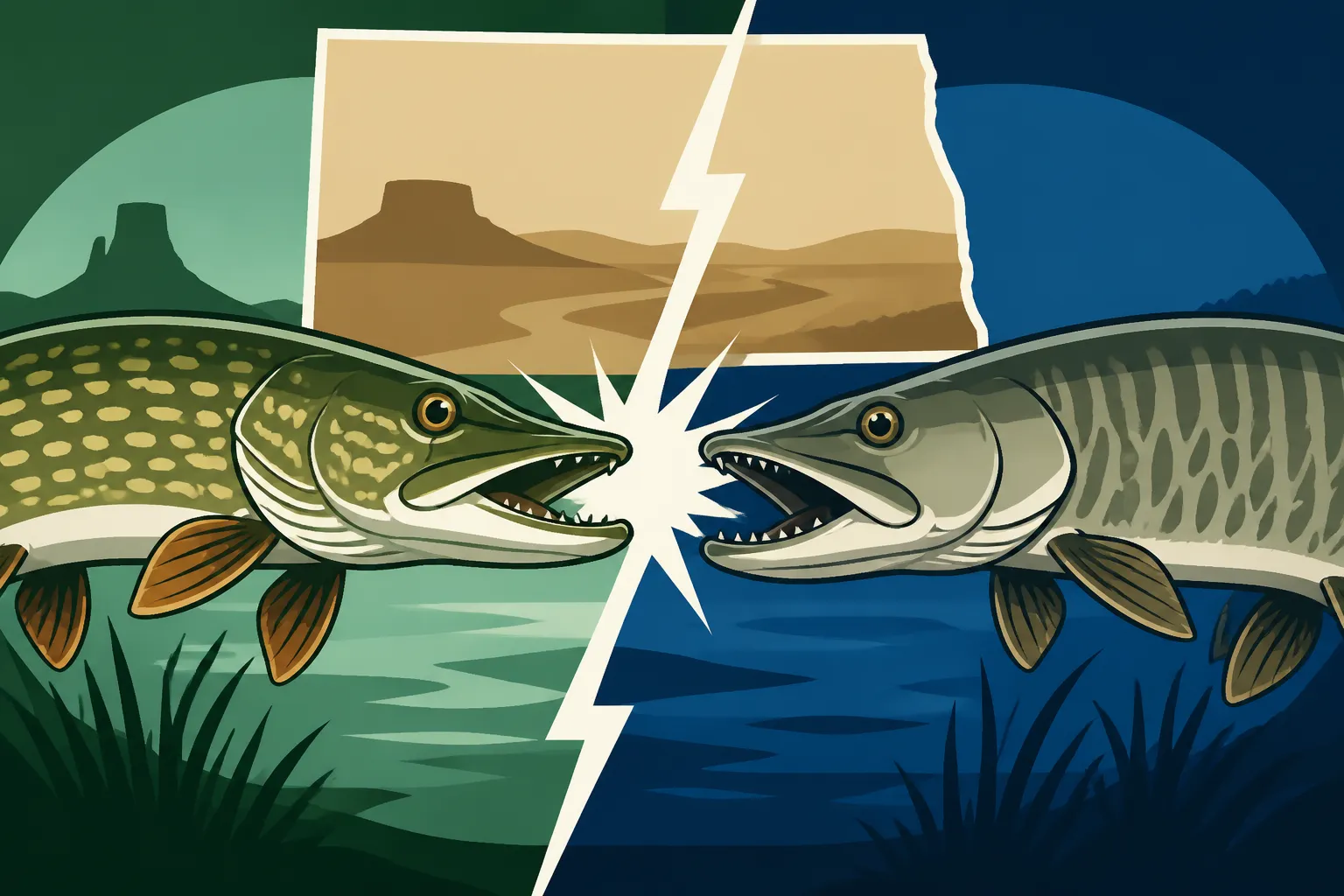
- Northern Pike: Typically have a darker, often olive-green to greenish-brown body, with lighter, bean-shaped or horizontal spots running along their sides. The background is dark, and the spots are lighter. These spots can sometimes form faint bars, but the dominant pattern is lighter spots.
- Muskellunge: Tend to have a lighter background color, usually a silvery-green to bronze, with darker markings. These markings can appear as distinct vertical bars ("tiger muskie" pattern, which we'll discuss more), dark spots, or blotches. The key is that the background is lighter, and the markings are darker.
Sometimes, in very clear water or certain light conditions, a pike's spots might look faint, or a muskie's bars might be subtle. That's why relying on the cheek and operculum is crucial, but body patterns can definitely help confirm your hunch.
Tail Shape and Fin Characteristics
Another subtle but often helpful distinction lies in the shape of their caudal (tail) fin.
- Northern Pike: Often have a more rounded or bluntly forked tail. The tips of the two lobes of the tail fin tend to be more rounded. Their fins (dorsal, anal, caudal) are frequently tipped with reddish-orange or yellowish hues, especially the lower fins.
- Muskellunge: Generally have a more sharply pointed or deeply forked tail. The tips of the tail fin lobes are typically more elongated and pointed. Muskie fins usually lack the distinct color tipping found on pike and are often duller, more grayish or mottled.
Again, this isn't as foolproof as the scale count, as tail shape can be influenced by damage or individual variation, but it's another piece of the puzzle to look for.
Jaw Pores: Another Reliable Identifier
If you're really determined to get it right, and you're handling the fish carefully for release, you can also count the sensory pores on the underside of their lower jaw. These are small, dark pits.
- Northern Pike: Typically have 5 or fewer jaw pores on each side of their lower jaw. Sometimes it's 4, sometimes 5.
- Muskellunge: Generally have 6 to 9, or sometimes even more, jaw pores on each side.
Counting these pores requires a very close look and should only be attempted if you're confident in handling the fish safely and quickly. It's a definitive identifier, but perhaps less practical for a quick field ID than the cheek scales.
Habitat and Behavior Clues
While not absolute rules, knowing where these fish typically hang out in North Dakota and how large they generally get can also give you some strong hints about what you've caught.
Where You're Likely to Find Each in North Dakota
North Dakota is a northern pike paradise! You can find them in virtually every decent-sized lake and river across the state. They thrive in a variety of conditions, from the vast expanses of Lake Sakakawea Fishing Guide for North Dakota Anglers to smaller prairie potholes, often preferring areas with heavy submerged vegetation, emergent reeds, or downed timber where they can ambush prey. They are incredibly adaptable.
Muskies, on the other hand, are much less common in North Dakota and are usually found in specific bodies of water where they have been intentionally stocked. These fisheries are often managed carefully to support these trophy fish. While muskies also like cover, they sometimes prefer slightly deeper, clearer water, or specific structural elements like rock reefs and sharp drop-offs. If you hook into a monster on a lake that isn't known for muskie stockings, chances are it's a truly exceptional pike. Best Fishing Lakes in the Turtle Mountains might have populations of both, so research is key!
Size and Growth Rates: Trophies vs. Giants
Both northern pike and muskies can grow to impressive sizes, making them coveted sport fish. However, muskies generally reach larger maximum sizes and live longer than pike.
A northern pike pushing 20 pounds is considered a true trophy in North Dakota, and anything over 30 pounds is a fish of a lifetime. The North Dakota Northern Pike State Record Weight stands as a testament to the size they can achieve here.
Muskies, however, are renowned for being the "fish of 10,000 casts" due to their elusive nature and potential for truly gargantuan dimensions. While a 30-pound muskie is also a trophy, they can regularly exceed this weight, with some truly massive specimens weighing 50 pounds or more in prime muskie waters across North America. North Dakota's muskie fisheries, while still developing compared to some other states, produce some fantastic fish. So, if you land something that just feels unbelievably heavy and long, beyond what you'd expect for a pike, it might just be that elusive muskie.
Dealing with Hybrid "Tiger Muskies"
Now, just when you thought you had it all figured out, let's throw a curveball: the "tiger muskie." These are a whole different beast, and they add another layer of complexity to identification.
What is a Tiger Muskie?
A tiger muskie is a sterile hybrid fish resulting from the cross-breeding of a northern pike and a muskellunge. They are almost always hatchery-produced and stocked because natural hybridization is quite rare. Fisheries managers often stock tiger muskies because they combine the fast growth rate of the muskie with the hardiness and slightly easier catchability of the pike. Plus, since they are sterile, they don't impact the genetic integrity of pure populations, and they focus all their energy on growing big!
Appearance-wise, they often feature a captivating pattern that looks like a blend of both parents, making them very distinctive once you know what to look for.
How to Identify a Hybrid Muskie in North Dakota
Identifying a tiger muskie can be simpler than a pure muskie or pike, thanks to its striking pattern, but the cheek/operculum scale pattern still holds true as the most definitive physical characteristic.
- Body Markings: This is the most obvious visual cue for a tiger muskie. They have dark, distinct, irregular vertical bars or blotches on a lighter background, giving them a "tiger-striped" appearance. This pattern is usually much more pronounced and wavy than the spots on a northern pike or the more uniform bars of a pure muskie. The combination of dark markings on a lighter body, with a clear, almost marbled or reticulated pattern, is the giveaway. If you see something that looks like a muskie but with super intense, almost jagged vertical stripes, it's likely a tiger muskie. How to Identify a Hybrid Muskie in North Dakota provides even more specific details.
- Cheek and Operculum Scale Pattern: For a tiger muskie, the scale pattern will typically be intermediate between a pike and a muskie. Often, you'll see a fully scaled cheek, like a pike, but the operculum might have more extensive scaling than a pure muskie, but less than a pure pike. However, the exact configuration can vary slightly. Because the body pattern is usually so distinct, it often overshadows the need for a precise scale count on tiger muskies. But if in doubt, the scales can still help.
- Jaw Pores: Similar to the pure muskie, tiger muskies usually have 6-9 or more jaw pores on each side, though this can sometimes be more variable due to the hybrid nature.
When in doubt, always err on the side of caution. If it looks like a muskie or a tiger muskie, treat it as such and follow the stricter regulations.
Practical Tips for Anglers
Catching either a northern pike or a muskie in North Dakota is an exciting experience. These are powerful, magnificent fish that deserve our respect, especially when it comes to handling them properly.
Catch and Release Best Practices for Large Predators
Because both pike and muskies are valuable game fish, and muskies in particular are often managed as trophy fisheries, proper catch-and-release techniques are absolutely vital for their survival.
- Be Prepared: Have your tools ready before you even cast. This means a large, rubberized landing net, long-nose pliers, and a jaw spreader (for deeply hooked fish). These tools are readily available on sites like Amazon or at local sporting goods stores.
- Land Quickly: Don't play the fish to exhaustion. Bring it to the boat or shore as efficiently as possible to minimize stress.
- Minimize Air Time: Keep the fish in the water as much as possible. If you need to take a photo, do it quickly, supporting the fish horizontally with both hands (one under the head, one under the tail). Never hold a large pike or muskie vertically by the jaw; this can cause severe damage to their internal organs and spine.
- Handle Gently: Wet your hands before touching the fish to protect its slime coat, which is crucial for preventing disease.
- Remove Hooks Carefully: Use your long-nose pliers or hook remover. If the fish is deeply hooked and the hook can't be removed quickly without causing major trauma, it's often better to cut the line as close to the hook as possible. The hook will usually corrode away.
- Revive Properly: If the fish seems sluggish, hold it gently in the water, facing into the current, until it can swim away strongly on its own.
Remember, the goal is to release these incredible predators in the best possible condition so they can grow even larger and provide another thrilling battle for future anglers.
Essential Gear for Handling Pike and Muskies
Having the right gear isn't just about making your life easier; it's about protecting these fish and yourself. Those teeth are no joke!
- Large, Rubberized Landing Net: A net with a wide hoop and rubberized mesh is critical. The rubber helps protect the fish's slime coat and prevents hooks from getting tangled. A big fish needs a big net.
- Long-Nose Pliers or Hook Remover: Absolutely essential for safely extracting hooks from those toothy jaws. Don't even think about fishing for these species without them.
- Jaw Spreader (Optional but Recommended): For those times when a hook is way down deep. A jaw spreader will prop open the fish's mouth, giving you access to the hook without putting your fingers at risk. You can find excellent quality jaw spreaders on Amazon.
- Heavy-Duty Gloves: Leather or cut-resistant gloves can protect your hands from teeth and gill rakers, especially when handling larger, feistier fish.
- Measuring Device: A bump board or flexible measuring tape is key for accurately measuring your catch to ensure it meets regulations, especially if you're targeting trophy fish.
By being prepared with the right tools and knowing how to use them, you're setting yourself up for a safer, more responsible, and ultimately more enjoyable angling experience here in North Dakota.
Disclaimer
This article is for general informational purposes only and does not constitute professional advice. Laws, prices and regulations vary by location and change over time. Consult a qualified professional for guidance on your specific situation.