Best Ice Shelter for a Family of Four
Trying to take your whole family out for a day of ice fishing in North Dakota, only to find yourselves crammed into a tiny, drafty shack, can quickly turn a fun outing into a freezing, frustrating mess. This guide is all about helping you pick the perfect ice shelter that offers enough space, warmth, and comfort to make those precious memories on the ice enjoyable for everyone, even the littlest anglers in your crew.
Why a Family-Sized Shelter is Essential for North Dakota Ice Fishing
Ice fishing in North Dakota is a truly special experience, but let's be honest, those winter days can be absolutely brutal. When you're bringing along a family of four, the challenges multiply if you don't have the right shelter. It's not just about fitting four people; it's about making sure everyone stays warm, comfortable, and actually enjoys the day, rather than shivering through it. A small, cramped shelter might be fine for one or two buddies on a quick trip, but for a family, it quickly becomes a recipe for disaster. The last thing you want is a grumpy child or a spouse cutting the day short because they can't feel their toes or can't move without bumping into someone.
Comfort and Warmth for All Ages
Imagine trying to keep a toddler happy and warm in a shelter barely big enough for two adults and their gear. It’s nearly impossible. Kids, especially, lose heat faster and get cold quicker than adults. A larger shelter, designed for families, provides that crucial extra space to spread out, allowing everyone to wear their layers comfortably without feeling restricted. More importantly, it creates a much more stable environment for your portable heater. In a bigger space, the heat can circulate better, reducing cold spots and ensuring a more consistent, cozy temperature inside, even when the wind howls outside. This means more smiles, longer stays on the ice, and a better chance of reeling in some keepers without frostbite concerns. What to Wear Ice Fishing in North Dakota is always important, but a good shelter adds another layer of protection.
Getting adequate warmth also means you can actually take off some of those bulky outer layers. When you're fishing, you want to be able to manipulate your rod and reel without feeling like the Michelin Man. A warm shelter allows for this, making the actual fishing process much more comfortable and enjoyable. Plus, there's room to set up a small folding table for snacks, hot chocolate, or even a quick game of cards while waiting for the bite. It transforms the ice fishing experience from a test of endurance into a genuine family outing.
Ample Space for Gear and Movement
A family of four comes with a lot of gear. Think about it: four fishing rods, four buckets, a portable heater, a tackle box, a cooler with snacks and drinks, extra layers, maybe a portable toilet, and certainly an Ice Fishing Auger Techniques for drilling holes. Trying to stuff all of that into a small shelter leaves no room for actual fishing or even just moving around. A family-sized shelter, by its very nature, provides the square footage needed to accommodate all this gear without tripping over it. This allows for a more organized setup, reducing clutter and the risk of accidents.
Moreover, the ability to move freely inside the shelter is a game-changer. Imagine being able to stand up, stretch your legs, or help a child with a tangled line without having to contort yourself into a pretzel. This extra space also means you can drill multiple holes inside the shelter, allowing everyone to fish simultaneously without getting in each other's way. If someone needs a break, they can lean back against a bucket or a folding chair without infringing on someone else's fishing space. It’s about creating a functional fishing station that caters to everyone's needs, making the experience far less stressful and much more productive.
Key Features to Look for in a Family Ice Shelter
When you're shopping for an ice shelter for a family of four, it's easy to get overwhelmed by all the options. However, focusing on a few critical features will help you narrow down the choices and find the perfect fit for your North Dakota adventures. Think about how you typically fish, how far you travel, and what kind of comfort level your family expects.
Size and Layout Considerations
The primary concern for a family of four is, of course, the actual living space inside. Most manufacturers will rate shelters by the number of people they can "fit." For a family of four, you'll want to look for shelters rated for 4-6 people, or sometimes even 6-8, especially if you plan on bringing a lot of gear or want extra elbow room. Don't just go by the "person" rating; check the actual square footage or dimensions. A 4-person shelter might be cozy, but a 6-person model often provides that sweet spot of comfort and usability for four people and their gear.
Consider the height of the shelter as well. Being able to stand up fully, or at least mostly upright, makes a huge difference in comfort, especially over several hours. Look for models with a center height of at least 70-80 inches. Also, pay attention to the floor plan: some shelters are more square, offering open communal space, while others might be more rectangular, which can be good for spreading out multiple holes in a line. A common feature in family shelters is multiple doors, which can prevent bottlenecks when people are coming and going, especially with kids. Some models even offer optional floor systems, which can provide an extra layer of warmth and a cleaner surface, though they do add to the setup time and weight.
Insulation and Durability
North Dakota winters demand serious insulation. This isn't an area where you want to cut corners. Look for shelters made with heavy-duty fabric, often 600D (denier) or higher, with thermal insulation. Fully insulated shelters, which have insulation quilted into the fabric of the roof, walls, and sometimes even the skirts, are absolutely worth the investment. This thermal barrier significantly reduces heat loss, making your heater much more efficient and keeping the interior noticeably warmer. It also helps prevent condensation, which can be a real nuisance in non-insulated shelters, leading to dripping water and a damp interior. How Cold It Gets Ice Fishing in North Dakota means insulation is paramount.
Beyond insulation, durability is key. Your shelter needs to stand up to brutal winds, heavy snow, and constant setup and takedown. Look for strong, large-diameter poles (for hub shelters) or robust metal frames (for flip-overs). Reinforced corners, heavy-duty zippers, and strong anchor points are all indicators of a well-built shelter that will last for many seasons. Brands like Clam, Eskimo, and Shappell are known for producing durable, high-quality shelters designed for harsh conditions. You can often find a good selection of these at retailers like Bass Pro Shops or through online stores such as Amazon. Checking reviews from other North Dakota anglers can give you real-world insights into how well a particular model holds up against our challenging weather.
Portability and Ease of Setup
Even a family-sized shelter needs to be reasonably portable. While it won't be as light as a single-person shack, you still need to be able to transport it from your vehicle to your chosen fishing spot. Consider the packed size and weight. If you're using an Best Ice Fishing Sled for Hauling Gear, most hub shelters will fold down into a duffel bag, while flip-overs have an integrated sled. Think about how you'll be getting your gear to the hole – will you be pulling it by hand, using a snowmobile, or driving right onto the ice?
Ease of setup is another crucial factor, especially when you have impatient kids or are dealing with biting winds. Hub-style shelters are generally very quick to set up, popping out like an accordion. Flip-over shelters, while heavier, can be even faster if they're already loaded on your sled, as you simply "flip" them over into position. Look for designs that minimize the number of poles or connections needed, and prioritize shelters with strong, easy-to-use hubs and robust zippers that won't freeze up. The quicker you can get warm and fishing, the happier everyone will be. Setting Up an Ice Fishing Shelter is a skill you'll master quickly with a good design.
Types of Family Ice Shelters: Hub vs. Flip-Over
When it comes to ice shelters for a family, the choice usually boils down to two main types: hub shelters and flip-over shelters. Both have their dedicated fan bases, and each offers distinct advantages and disadvantages that make them more or less suitable for different family fishing styles. Understanding these differences is key to making the best decision for your crew.
Hub-Style Shelters: Spacious and Social
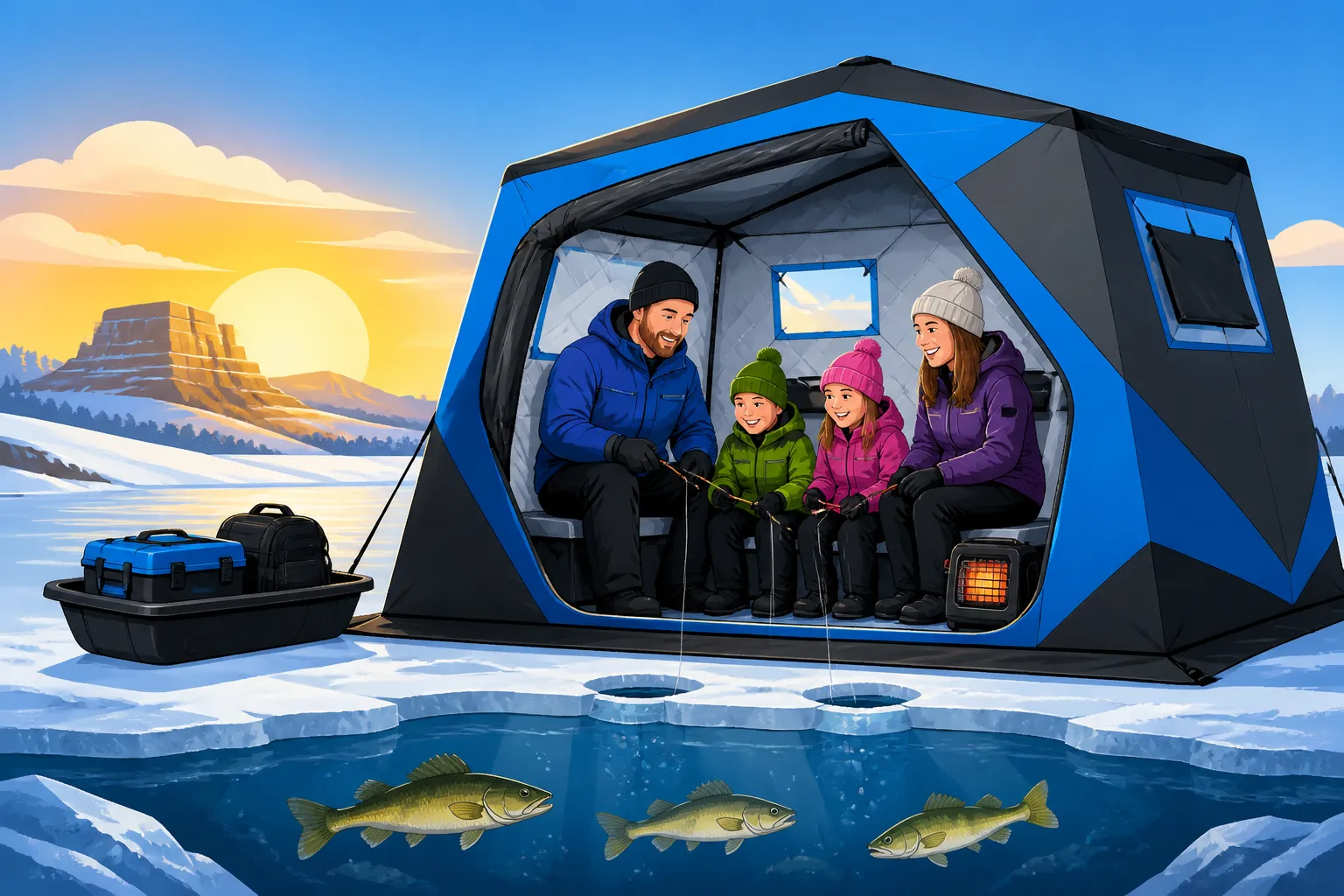
Hub-style shelters are the pop-up tents of the ice fishing world. They feature a central hub system with flexible poles that extend out to create a roomy, often square or hexagonal, interior. These shelters are incredibly popular for families due to their generous interior space and relatively light packed weight for their size. When fully deployed, a large hub shelter can feel like a small room on the ice, offering plenty of space for four anglers, multiple holes, and all your gear. They often have tall ceilings, allowing most adults to stand up comfortably, which is a huge plus for longer outings.
One of the biggest advantages of hub shelters is their social aspect. The open, unobstructed interior lends itself well to conversation and shared experiences, making it easy for family members to interact. They are also relatively quick to set up and take down once you get the hang of it, often just a few minutes, even for larger models. However, they do require anchoring into the ice, which takes a few extra minutes, and they can be more susceptible to strong winds if not properly secured. You also need a separate method to transport your gear, usually an ice fishing sled. If you're looking for maximum interior space, ease of movement, and a social fishing experience, a thermal hub shelter for 4-6 people is often the top choice for families. Many brands offer excellent thermal hub options, and you can compare them easily on websites like Amazon or in stores like Bass Pro Shops.
Flip-Over Shelters: Mobile and Convenient
Flip-over shelters, also known as sled-style shelters, are built directly onto a durable plastic sled. The shelter fabric and frame are hinged, allowing you to simply "flip" the top half over to deploy the shelter. This design offers unparalleled mobility and convenience, especially if you like to move around the lake to find the fish. Since all your gear can be stored and transported within the sled, you simply pull the whole unit to your spot, flip it open, and you're ready to fish. This integrated system saves a lot of time and effort in packing and unpacking.
For a family of four, you'd typically look at a 3-4 person flip-over, which often means two adults and two children can fit reasonably well, especially if you prioritize being able to move quickly. The sled itself also provides a solid, insulated floor, which can be a comfort bonus. While generally heavier and a bit more expensive than hub shelters of comparable size, their instant setup and breakdown, combined with integrated gear transport, make them incredibly efficient. They also tend to be very robust in windy conditions due to their lower profile and heavier base. If your family enjoys being mobile, jumping from spot to spot, and values quick setup and integrated storage, a well-insulated flip-over shelter can be an excellent choice.
Comparison of Hub and Flip-Over Shelters for Families
To help you decide, here's a quick comparison of key features for family ice fishing:
| Feature | Hub-Style Shelter | Flip-Over Style Shelter |
|---|---|---|
| Interior Space | Excellent, very roomy, often standing height for all. | Good, but typically less overall floor space than hubs of similar person rating. |
| Portability | Relatively lightweight when packed; separate sled needed for gear. | Heavier; integrated sled for gear, pull entire unit. |
| Setup Speed | Quick pop-out action; requires anchoring. | Extremely fast "flip" deployment; no anchoring often needed. |
| Wind Resistance | Good, if properly anchored; can catch wind. | Excellent, low profile; very stable. |
| Insulation | Highly variable; thermal models are excellent. | Often well-insulated due to rigid frame and floor. |
| Cost | Generally lower for comparable space. | Higher, due to integrated sled and frame. |
| Gear Transport | Requires separate ice sled. | Sled doubles as transport and base for shelter. |
| Best For | Longer stays, social fishing, larger groups, comfort. | Mobile anglers, quick moves, integrated setup. |
When considering a large hub shelter for maximum space, you might look at options like the Clam Outdoors X-600 Thermal, which is incredibly popular for its roominess and warmth. If a flip-over is more your style for its mobility, an Eskimo FatFish 949i or a Shappell FX200 could be a good starting point, though for a true family of four, you'd want to ensure sufficient space, possibly going for a larger 3-4 person model.
Setting Up and Maintaining Your Family Ice Shelter
Once you've made the big decision and brought home your ideal family ice shelter, the journey isn't over. Knowing how to properly set it up, secure it, and maintain it will ensure its longevity and, more importantly, the comfort and safety of your family on every single North Dakota ice fishing trip. Don't underestimate the importance of these practical steps.
Deployment and Anchoring Techniques
Setting up your ice shelter effectively is crucial, especially on those blustery North Dakota days. For a hub-style shelter, the process usually involves laying it flat, extending the poles from the central hubs until the walls pop out, then pulling out the roof section. The key is to do this systematically, starting with the windward side if it's windy, to prevent it from acting like a kite. Once the structure is up, proper anchoring is absolutely essential. Most shelters come with ice anchors that screw into the ice. For a family-sized hub shelter, you'll want to use all available anchor points, typically one at each corner and sometimes midway along larger walls. You can even use guy lines from the roof if the wind is really howling. Best Portable Ice Shelters for Wind often feature strong anchor points and reinforced fabrics. Make sure you use a cordless drill with an anchor adapter to quickly and securely drill those anchors in – it's a huge time saver.
For flip-over shelters, deployment is often simpler. You position the sled where you want it, unclip the cover, and "flip" the rigid frame and fabric forward until it locks into place. Many flip-overs have an integral bench or seat that also helps support the structure. While less prone to blowing away due to their heavier base, it's still a good idea to secure them, especially if you plan on leaving it set up for an extended period or during high winds. Some models have external skirt tie-downs or internal anchor points. Regardless of the type, always clear any significant snow or slush from your intended spot before setting up, as this can make anchoring difficult and create a cold, wet base.
Heating and Ventilation for Safety
Keeping your family warm is a top priority, but safety must always come first. Using a portable propane heater inside your ice shelter is common, but it requires careful attention to ventilation. Any combustion heater produces carbon monoxide, an odorless, colorless gas that can be deadly. Even with a well-insulated shelter, you must ensure adequate fresh air flow. Most modern ice shelters are designed with ventilation in mind, often featuring adjustable vents. Make sure these are open. It’s a delicate balance between retaining heat and allowing for proper airflow.
Furthermore, investing in a battery-powered carbon monoxide detector is not just a good idea, it's absolutely critical for family safety. These are relatively inexpensive and can literally save lives. Place it inside your shelter, preferably near where people are sitting or sleeping, if applicable. Always keep your heater well-maintained and never leave it unattended for extended periods, especially with children present. Remember that even on moderately cold days, the temperature inside a properly ventilated shelter can be kept quite comfortable, often allowing you to shed heavy outer layers.
Storage and Maintenance for Longevity
Taking care of your ice shelter at the end of each season, and even after each trip, will dramatically extend its life. After a day on the ice, always make sure to thoroughly dry your shelter before packing it away. Moisture is the enemy; it can lead to mildew, mold, and even damage to zippers and fabric over time. If you can, set it up in your garage or basement for a day or two to air dry completely. If you pack it away wet, you'll open it up next season to a nasty surprise.
Inspect your shelter regularly for any wear and tear. Check zippers for smooth operation, look for small tears or holes in the fabric, and examine poles or frames for bends or cracks. Small repairs, like patching a tear with a fabric repair kit, are much easier and cheaper to address early on than waiting until they become major issues. Store your shelter in a cool, dry place, ideally in its original bag, away from direct sunlight and extreme temperatures. A little bit of care goes a long way in ensuring your family's ice fishing home is ready for countless more adventures on North Dakota's frozen waters. North Dakota Ice Fishing Rules also often have guidelines about shelter removal, so be sure to check those out.
Disclaimer
This article is for general informational purposes only and does not constitute professional advice. Laws, prices and regulations vary by location and change over time. Consult a qualified professional for guidance on your specific situation.