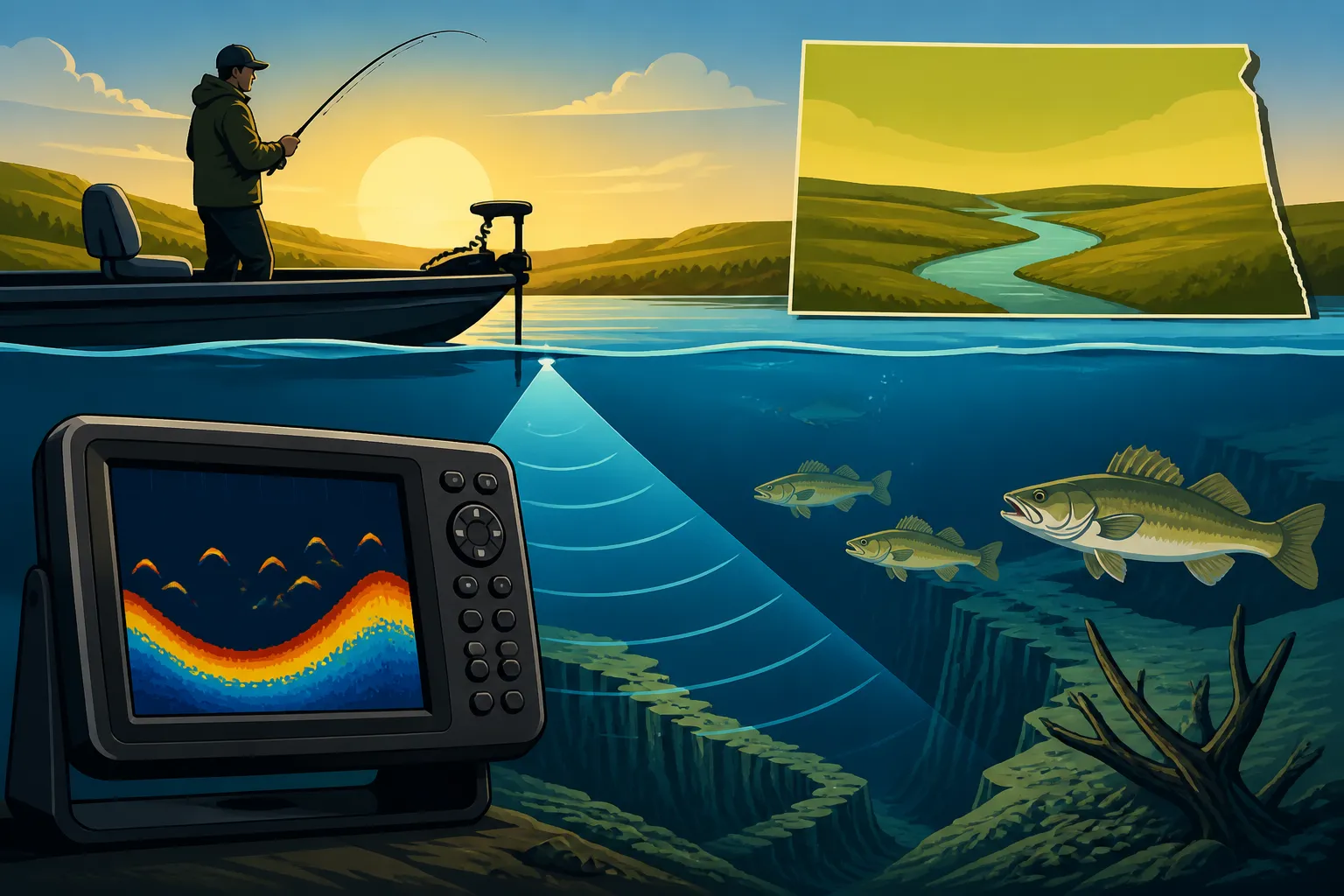
Best Fish Finder for Deep Water Structure
There are few things more frustrating than staring at a vast expanse of water, knowing that trophy fish like walleye and sauger are lurking in deep structure, but having no idea how to find them. North Dakota's expansive lakes, with their incredible depths and complex underwater terrain, can feel like an impossible puzzle. This guide is here to unravel that mystery, helping you understand what makes a fish finder truly excel when you're targeting those elusive deep-water fish and structure.
The Unique Challenges of Deep Water Structure Fishing in North Dakota
Fishing the vast, deep waters of North Dakota isn't like casting a line into a small pond. Our major reservoirs, especially Lake Sakakawea Fishing Guide for North Dakota Anglers and Lake Oahe Fishing Guide, present anglers with immense challenges when trying to locate fish holding to deep structure. The sheer scale and depth can make traditional fishing methods feel like searching for a needle in a haystack.
Vastness and Depth of North Dakota's Premier Lakes
Imagine trying to find a small rock pile or a subtle depth change in a body of water that stretches for hundreds of miles and can be over 100 feet deep in places. That's the reality of fishing lakes like Sakakawea. These aren't just big lakes; they are complex underwater worlds with old river channels, submerged towns, vast flats, and sudden drop-offs. Conventional sonar, with its narrow cone angle, struggles to effectively scan these immense areas, making it incredibly difficult to identify promising structure quickly and efficiently.
The water itself can also play a role. Clarity varies, and even in clear conditions, light penetration only goes so far. You're relying entirely on technology to "see" what's beneath your boat, and if your equipment isn't up to the task, you're essentially fishing blind in the dark depths. Understanding the contours and subtleties of these deep-water havens is paramount, and a basic fish finder simply won't cut it.
Targeting Deep-Holding Species
Many of North Dakota's most prized game fish, especially walleye and sauger, have a strong affinity for deep water structure. During certain times of the year, or even specific times of day, these fish will relate tightly to submerged humps, deep points, old creek beds, or sheer rock walls. They use these features for ambush points, protection from current, or as temperature breaks.
Finding these specific deep-water hangouts is crucial for consistent success. If you're marking fish suspended in the middle of nowhere, they might be baitfish, or they might be transient. But when you mark fish directly on or just above a distinct piece of deep structure, your odds of a bite skyrocket. This requires a fish finder capable of not just marking fish, but clearly delineating the structure they're relating to.
Environmental Factors Affecting Sonar Performance
North Dakota's weather is notoriously unpredictable, and it can throw a wrench into even the best fishing plans. High winds often whip up considerable waves on large lakes, making it tough for a transducer to maintain a consistent signal. Aerated water from heavy chop can interfere with sonar waves, causing a noisy and cluttered display.
Beyond the waves, cold water temperatures can sometimes influence how sonar travels, and deeper water itself can attenuate signals. Your fish finder needs to have robust signal processing and transducer technology to cut through these environmental challenges and deliver a clear, reliable picture of the depths, regardless of what's happening on the surface. Without a clear signal, even the most advanced features become useless.
Essential Technologies for Unlocking Deep Water Structure
When you're trying to peer into the abyssal depths of Lake Sakakawea or locate a subtle hum in Lake Oahe, not all fish finders are created equal. The right technology can be the difference between a frustrating day of searching and a productive day of fishing. It's about getting a clear, detailed picture of what's beneath your boat, far beyond what traditional sonar can offer.
CHIRP Sonar: The Game Changer for Depth
Traditional 2D sonar sends out a single frequency pulse and listens for the return. It's like shouting one word into a canyon and waiting for an echo. While effective in shallower water, this can lose detail and struggle with interference in deeper applications. This is where CHIRP (Compressed High-Intensity Radiated Pulse) sonar truly shines.
CHIRP sonar sends out a continuous sweep of frequencies, from low to high, instead of a single pulse. Think of it as singing a whole scale into the canyon. When these broader-band signals return, the fish finder's processor compiles them, creating an incredibly detailed image. This results in superior target separation—meaning you can differentiate between a walleye and the rock it's hiding behind, or even separate individual fish within a school. More importantly for deep water, CHIRP offers exceptional depth penetration and reduced noise, giving you a much clearer picture of structure and fish holding deep, even at 100 feet or more.
Down Imaging and Side Imaging for Detailed Views
While CHIRP sonar gives you fantastic detail directly below the boat, Down Imaging (DI) and Side Imaging (SI) provide a photographic-like view, almost like an X-ray of the underwater world. These technologies use higher frequencies and very narrow, fan-shaped beams to create incredibly sharp images of structure and fish.
Down Imaging offers a direct, high-resolution view of what's immediately beneath your boat, showing rock piles, trees, or ledges with remarkable clarity. Side Imaging takes it a step further, scanning out to the sides of your boat (sometimes up to 250 feet or more on each side), giving you a panoramic view of the lakebed. This is absolutely invaluable for covering large areas quickly and finding hidden structure that you might never pass directly over with 2D sonar. Imagine seeing a submerged roadbed off to your left while you drive over open water – that's the power of Side Imaging.
GPS Mapping and Detailed Lake Charts
Finding deep water structure is one thing; consistently returning to it and understanding its relationship to the surrounding contours is another. This is where a robust GPS system with highly detailed lake charts becomes indispensable. Standard GPS might show you a basic outline, but advanced bathymetric charts provide contour lines, depth changes, and even highlights of potential structure.
With detailed maps, you can identify promising areas before you even launch your boat. Once you find a productive deep hump or break line, you can mark a precise waypoint, allowing you to return to that exact spot time and time again, regardless of wind or changing conditions. This ability to navigate precisely and mentally map the underwater landscape gives you a huge advantage when chasing fish that relate to specific deep structures, especially on massive bodies like Lake Sakakawea. A feature like How to Find Walleye Structure With a Map becomes a lot easier when you have detailed charts on your unit.
Key Features to Consider for North Dakota's Deep Water
When you're investing in a fish finder specifically for North Dakota's deep water and challenging structure, it's not just about having the latest technology. It's about how those technologies are implemented and what additional features make the unit robust and user-friendly in real-world fishing scenarios. From the power of the signal to the clarity of the screen, every detail matters.
Transducer Power and Cone Angle for Deep Penetration
The transducer is the heart of your fish finder, sending and receiving sonar signals. For deep water, you need a transducer with sufficient power (wattage) to penetrate to those depths and get a clear return. Units with higher RMS (Root Mean Square) wattage will generally perform better in deeper water and provide more detail. Don't confuse RMS with peak-to-peak power; RMS is the more reliable indicator of sustained power output.
The cone angle of your transducer is also critical. A wider cone covers more area but can lose resolution and clarity in deep water. A narrower cone (e.g., 20 degrees or less) maintains better detail and target separation at depth, which is excellent for pinpointing specific structure directly beneath the boat. However, many advanced units offer multiple cone angles or CHIRP transducers that effectively use a range of angles, giving you versatility. You'll want to check the specifications to ensure your chosen unit provides the right balance for probing those deep North Dakota spots.
Screen Size, Resolution, and Display Quality
What good is all that powerful sonar data if you can't clearly see it? For deep water fishing, where subtle changes in structure or faint fish arches are key, screen size and resolution are paramount. A larger screen (7 inches or more is often recommended) gives you more real estate to display multiple sonar views simultaneously – perhaps 2D CHIRP, Down Imaging, and a map, all at once.
High resolution (more pixels) ensures that the images are crisp and detailed, reducing eye strain and preventing you from missing crucial information. Imagine trying to differentiate a small rock from a submerged log on a blurry, low-resolution screen at 80 feet down – it's nearly impossible. Look for units with high-definition displays that are bright enough to be visible in direct sunlight, and consider anti-glare coatings, especially when fishing under the wide-open North Dakota sky. This greatly enhances your ability to interpret Best Fish Finder Settings for Walleye or Best Sonar Settings for Finding Baitfish data.
User Interface and Durability
Even the most technologically advanced fish finder won't help you if it's a nightmare to operate. A user-friendly interface with intuitive menus and easily accessible controls is essential, especially when you're on the water in challenging conditions, perhaps trying to keep your boat positioned over a deep hum in strong winds. Some anglers prefer touchscreen models for quick navigation, while others prefer physical buttons for tactile feedback in rough conditions or with wet hands.
Beyond ease of use, durability is non-negotiable for North Dakota fishing. Your unit needs to be built to withstand temperature extremes, from freezing ice fishing days to scorching summer heat. It should be waterproof or highly water-resistant, capable of handling splashes, rain, and unexpected waves. Investing in a robust unit from a reputable brand ensures it will hold up to the rigors of our diverse fishing seasons and continue to perform reliably when you need it most.
Choosing the Right Fish Finder for Your North Dakota Deep Water Structure Pursuits
Selecting the best fish finder for deep water structure in North Dakota involves weighing your budget against the features you truly need to gain an edge. With several excellent brands on the market, each offering a range of technologies, it can feel a bit overwhelming. But by focusing on the core capabilities crucial for our deep, vast lakes, you can make an informed decision that will significantly improve your fishing success.
Entry to Mid-Range Options for the Dedicated Angler
For anglers who are serious about deep water fishing but might not be ready for the top-tier investment, there are fantastic entry to mid-range options available. These units typically integrate powerful CHIRP sonar, offering that superior target separation and depth penetration that's so vital. Many in this category also include basic Down Imaging and reliable GPS with pre-loaded mapping, giving you a solid foundation for finding and marking deep structure.
While they might not have the largest screens or the most advanced networking capabilities of their more expensive siblings, these fish finders provide immense value. They are a significant step up from basic 2D sonar and will reveal a world of underwater detail you might have been missing. You can often find a wide selection of these models at reputable retailers like Bass Pro Shops, where you can compare features side-by-side, or conveniently browse the options available online through Amazon.
Advanced Systems for the Serious North Dakota Pro
If you're an avid angler who spends countless hours dissecting the deep contours of Lake Sakakawea or chasing elusive sauger on the Missouri River, an advanced fish finder system is a worthwhile investment. These units typically feature high-power, multi-frequency CHIRP sonar, combined with high-definition Down Imaging and expansive Side Imaging that can scan hundreds of feet to either side of your boat.
Look for large, high-resolution screens (10 inches or more) that allow for detailed multi-pane displays, letting you view sonar, side imaging, and a detailed chartplotter simultaneously. Advanced GPS capabilities, including detailed bathymetric charts, allow for precise navigation and the ability to upload custom maps. These systems often include advanced networking features, allowing you to connect multiple units, trolling motors, and even radar for a fully integrated fishing platform. Such a setup gives you an unparalleled view of the underwater world, turning every deep-water expedition into a high-tech search and conquer mission. For truly serious anglers, this is the gear that helps locate the best deep water structure consistently.
Comparative Look at Deep Water Fish Finder Features
Here’s a quick overview of what to expect across different tiers of fish finders when focusing on deep water structure. Keep in mind that specific models and their features will vary, so always check the detailed specifications.
| Feature Category | Entry-Level Options (Budget-Friendly) | Mid-Range Options (Excellent Value) | High-End Options (Pro-Level Performance) |
|---|---|---|---|
| Primary Sonar | Basic 2D Sonar, sometimes basic CHIRP | Full-spectrum CHIRP Sonar | Multi-frequency High-Definition CHIRP Sonar |
| Imaging Technology | Limited Down Imaging (DI) | Good Down Imaging (DI) & basic Side Imaging (SI) | High-Definition Down Imaging (DI) & Wide-Scan Side Imaging (SI) |
| Depth Capability | Adequate for moderate depths (100-200 ft) | Very Good for deep water (300-500+ ft) | Exceptional for extreme depths (1000+ ft or more) |
| Screen Size | 5-7 inches | 7-9 inches | 10-16+ inches |
| Screen Resolution | Standard resolution | High-resolution, clear display | Ultra-high definition, superior clarity |
| GPS & Mapping | Basic GPS, minimal pre-loaded maps | Reliable GPS, good pre-loaded lake charts | Advanced GPS, highly detailed bathymetric mapping, custom mapping |
| Target Separation | Basic | Very good, clearly distinguishes fish from structure | Excellent, distinguishes individual fish, baitfish schools |
| Networking | Limited to none | Basic networking for transducers/accessories | Full networking with trolling motors, radar, multiple displays |
| Durability | Good, splash-proof | Very good, weather-resistant | Excellent, built for extreme conditions, highly water-resistant |
Remember, while the initial cost might seem daunting, a quality deep water fish finder is an investment in your fishing success and enjoyment. Consider your typical fishing grounds, the species you target, and your personal comfort level with technology. Whether you opt for a feature-packed mid-range unit or a top-tier system, the ability to clearly visualize North Dakota's deep underwater structure will undeniably elevate your game. This is especially true when combined with knowledge from guides like Best Boats for North Dakota Lakes and proper North Dakota Boat Registration Guide.
Disclaimer
This article is for general informational purposes only and does not constitute professional advice. Laws, prices and regulations vary by location and change over time. Consult a qualified professional for guidance on your specific situation.